
Coordinate Geometry - An Introduction
This basic coordinate geometry course introduces students to the coordinate plane and teaches them how to plot points using ordered pairs (𝑥,𝑦).
Students will learn how to draw straight lines accurately on graph paper by plotting points and joining them neatly. The course also introduces the concept of the gradient of a straight line. Students will learn how to calculate the gradient using the rise over run method as well as the gradient formula, using a mathematical method to measure the steepness of the slope of a straight line.
How To Read XY-Coordinates On Cartesian Plane
First, we learn how to read Cartesian coordinates on the coordinate plane. Each point is described using two values: the x-coordinate and the y-coordinate.
The x-coordinate tells us how far the point is from the origin along the x-axis (left or right), while the y-coordinate tells us how far it is along the y-axis (up or down).
When reading Cartesian coordinates, we always read the x-axis value first, followed by the y-axis value, and write it in the format \((x, y)\) — open bracket, x, comma, y, close bracket.
This \((x, y)\) order is important, as swapping the values will place the point in a completely different position on the graph.
Plotting Straight Line On Graph Paper
When plotting a straight line on graph paper, there are a few important points to remember:
- At least two points are needed to form a straight line.
- Three points is recommended as it helps check for any calculation mistakes.
- Whenever possible, choose coordinate pairs with whole numbers to make plotting easier and more accurate.
- Select points that are far apart on the graph to improve accuracy. One best practice is to select one point on the extreme left, one on the extreme right, and the last point in the middle of the first two points.
What Is Gradient?
If you look at the two slopes above, you can see that slope B is steeper than slope A. However, to compare slopes accurately, we need a mathematical way to describe how steep a slope is.
By forming a right-angled (90°) triangle on the slope and dividing the vertical height by the horizontal distance, we obtain the mathematical definition of the gradient. Often described as rise over run, the gradient formula is:
\(gradient=\frac{vertical- height}{horizontal-distance}\)
Method 1: Using Rise Over Run
Method 1 using the definition of gradient, which is \(gradient=\frac{vertical- height}{horizontal-distance}\):
- Step 1: Identify 2 sets of coordinates pair, ideally select whole numbers for the coordinate values. In this case, we have selected (0, 1) and (7, 3).
- Step 2: Form a right angle triangle using the two coordinate pairs.
- Step 3: Measure the change in the y-value, also known as the rise, which is \((3-1)\), to get 2. Then measure the change in the x-value, also known as the run is \((7-0)\), and the result is 7.
- Step 4: The gradient is the ratio of the vertical distance and the horizontal distance. Therefore, the gradient of this line is \(\frac{2}{7}\).
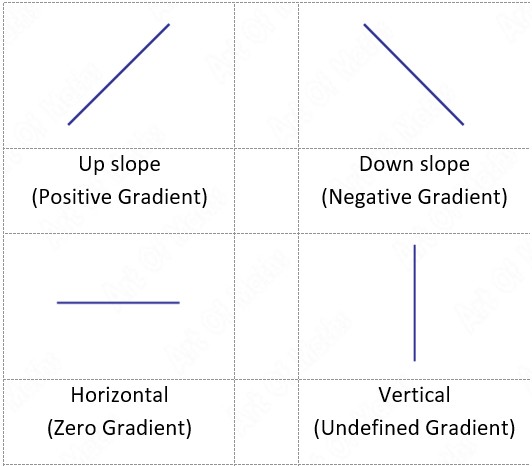
But what if two lines have the same gradient, but one line is upslope, while another line is down slope. In this case
- Up slope – gradient is positive
- Down slope – gradient is negative
- Horizontal line – gradient is 0
- Vertical line – gradient is undefined
Method 2: Using Gradient Formula
The second method is to make use of the gradient \((m)\) formula
\(m=\frac{y_2-y_1}{x_2-x_1}\)
The steps to calculate the gradient is much simplier:
- Step 1: Identify 2 sets of coordinates pair, ideally select whole numbers for the coordinate values.
- Step 2: Label the two pairs of coordinates \(\left(x_1,y_1\right)\) and \(\left(x_2,y_2\right)\) respectively
- Step 3: Substitute the coordinate values into the gradient formula to get the answer
Equation of Horizontal and Vertical Lines
Lastly, we will learn how to label the equation of a horizontal & vertical line:
- For a horizontal line, it cuts only the y-axis. Hence the equation will be in the form \(y=?\), where “?” is the \(y\) value where the line cuts the y-axis.
- For a vertical line, it cuts only the x-axis. Hence the equation will be in the form \(x=?\), where “?” is the \(x\) value where the line cuts the x-axis.