
Real Number & Integers
This video course introduces the Real Number System, focusing on the relationship between different parts of the system.
Students will learn the commonly used symbols for representing real numbers and understand the mathematical meaning of reciprocals.
The course also covers how to represent recurring decimals clearly, and how to use method of estimation to evaluate an expression without the use of calculator.
Finally, students will learn a step-by-step method to solve mountain temperature questions using a simple diagram, helping them confidently visualise values above and below zero.
Introducing The Real Number System
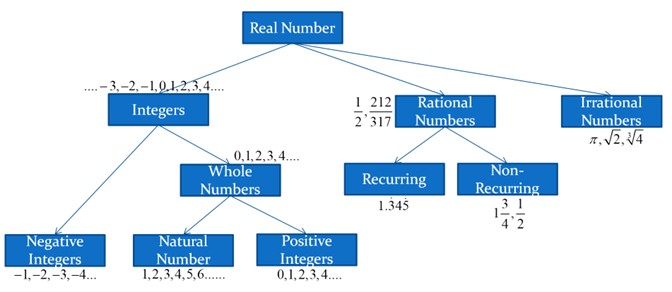
This course starts by providing a clear and structured introduction to the Real Number System, beginning with the hierarchy of real numbers and how different types of numbers are related.
- Real Numbers: integers, rational numbers & irrational numbers
- Integers: whole numbers, negative integers, natural numbers and zero
- Rational Numbers: recurring and non-recurring numbers
- Irrational Numbers
Special Symbols For Real Number System
Here are some of the commonly used special symbols to describe the real number system:
- \(R\) represents the set of all real numbers on the number line
- \(N\)represents the set of all natural or counting number {1, 2, 3, 4, 5, 6, 7…..}
- \(Z\) represents the set of all integers { – 4, – 3, – 2, – 1, 0, 1, 2, 3….}
- \(Z^+\) represents the set of all positive integers {0, 1, 2, 3….}
- \(Q\) represents all rational numbers in the form \(\frac{p}{q}\) where p and q are integers and \(q\neq0\)
Reciprocal
The reciprocal of a number is dividing the number 1 by the original number.
- Reciprocal of 2 is \(\frac{1}{2}\)
- Reciprocal of \(\frac{3}{4}\) is \(\frac{4}{3}\)
- Reciprocal of \(-\frac{5}{8}\) is \(-\frac{8}{5}\)
- Reciprocal of \(\frac{a}{b}\) is \(\frac{b}{a}\)
How To Write Recurring Decimal
Now, we will learn how to represent recurring numbers using standard recurring notation.
For example:
- \(0.88888…=0.\dot{8}\)
- \(50.787878…=50.\dot{7}\dot{8}\)
- \(1.345345345…=1.\dot{3}4\dot{5}\)
- \(2.447244724472…=2.\dot{4}47\dot{2}\)
In the first example, since the number “8” is repeated, we put a dot on top of the value 8.
In the second example, since “78” is repeated, we put a dot on both 7 & 8.
In the third example, since we have three numbers repeated, “345”, we put a dot on the first (“3”) and the last (“5”) number, skipping the number 4.
Lastly, since “4472” is repeated, we put a dot on the first “4” value and the final “2” value, skipping “47”.
Learn The Process Of Estimation
Now, we will learn how to use estimation to evaluate mathematical expressions efficiently by rounding appropriately and simplifying calculations to obtain reasonable approximations. We will learn the techniques by estimating the expression:
\(\frac{\sqrt[3]{125.107}+4.903^2}{\sqrt{35.896}}\)
Note that estimation questions may have more than one valid answer, clear and detailed working is essential for examiners to assess the solution. Here is one approach:
\[
\begin{align*}
\frac{\sqrt[3]{125.107}+4.903^2}{\sqrt{35.896}}
&≈\frac{\sqrt[3]{125}+5^2}{\sqrt{36}}\\
&=\frac{5+25}{6}\\
&=5\\
\end{align*}
\]
Mountain Temperature Question
The mountain temperature question is one where students are required to find the temperature or height of a mountain at a given point. Using the temperatures at the foot and the summit of the mountain, students will learn how to interpret the rate of temperature change and apply it accurately.
Here is the question:
It is given that the temperature at the top of a mountain is \(-7°C\) and the temperature at the foot of the mountain is 15°C.
- Find the difference in temperatures between the top and foot of the mountain.
- If the mountain has a height of 22000 m and the rate of change in temperature is constant, find how far he is from the bottom of the mountain if the temperature is 0°C.
- If the height is 10000m, what is the temperature?
Solution:
a) Different in temperature = \(15-\left(-7\right)=22°C\)
b) \(\frac{Height}{22000}=\frac{15}{22}\)
Height = 15000m
c) \(\frac{\operatorname{Temp}}{22}=\frac{10000}{22000}\)
Temp = 5°C
Temperature at 10,000 = \(15-10\)=5°C
For students who find solving this type of question challenging, the video at the end show a graphical visualisation on how to solve the mountain-temperature easily.
Watch Full Concept Breakdown
This video focuses on the Real Numbers & Integers chapter, where students will explore the real number system and understand how the different sets of numbers are related to one another. The video also provides a clear, step-by-step explanation on how to represent recurring decimals correctly. Finally, students will learn a simple pictorial method to solve mountain temperature questions more effectively.